
The goal of this training program is to support various stakeholders in local communities and ports in their efforts to achieve the Sustainable Development Goals.
A sustainable and smart port city is a community where stakeholders are able to develop a development model that seeks to strike a balance between the competitiveness of port and logistics operations, the quality of life for residents, the preservation of the natural environment, and social cohesion based on shared values and common visions for the future.
The program is structured around the 10 commitments of the AIVP Agenda 2030, namely:
Preparing Port Cities for the Consequences of Climate Change
Innovative and sustainable solutions for energy and industry in city-port regions
Promote dialogue between the City and the Port within a renewed governance framework.
Local port identity as a key asset for building a lasting relationship
Port cities play a vital role in the development of sustainable food logistics
The course is also available in Spanish.
The 5 courses must be taken in sequence, from Course 1 to Course 5.
By the end of the course, participants should be able to:
Fields of Study: Political Science, Public Policy Analysis.
Goal 4 of the 2030 Agenda: Promote dialogue between the city and the port within a renewed governance framework aimed at balancing the pursuit of economic and environmental performance with the well-being and aspirations of residents
By the end of the training, participants should be able to:
Fields of Study: Economics, Geography, Business and International Relations, Port Management and Logistics.
Goal No. 2 of the 2030 Agenda: To position our Ville Port territories at the heart of the energy transition and the circular economy, in true harmony with the various local stakeholders.
Goal No. 5: Improve mobility in the port city and combat urban congestion.
Goal No. 7: Make port cities key players in addressing the challenge of ensuring sufficient, high-quality food for all
By the end of the course, participants should be able to correctly apply the concept of quality of life and analyze the actions taken by the port and local authorities in terms of their contribution to the quality of life of the local population.
Fields of Study: Natural Sciences, Engineering, Social Sciences and Humanities (geography, urban planning, architecture, sociology).
By the end of the course, participants should be able to: (i) correctly apply the concepts of culture, identity, and heritage to the context of a port city; (ii) identify the factors that facilitate or, conversely, hinder the achievement of Goal 6 of the 2030 Agenda.
Fields of Study : Social Sciences and Humanities (history, urban planning, architecture, sociology).
2030 Agenda: Goal 6: Promote the distinctive culture and identity of port cities and restore residents’ pride in belonging to a port city community.
By the end of the course, participants should be able to develop a methodological proposal for a forward-looking exercise that helps move toward building a shared vision of the future by 2045.
Disciplines: Future Studies, Social Sciences and Humanities.
2030 Agenda: All the Goals.
At the end of the five courses covering Governance, Economics, the Environment, Heritage and Culture, and finally Future Studies, participants will be required to analyze a real-world case study in light of the objectives of the AIVP 2030 Agenda.
Projects may be individual or group projects.
In the Foresight course, participants will work in teams to propose the broad outlines of a foresight exercise for a sustainable port city over a 20-year time horizon.

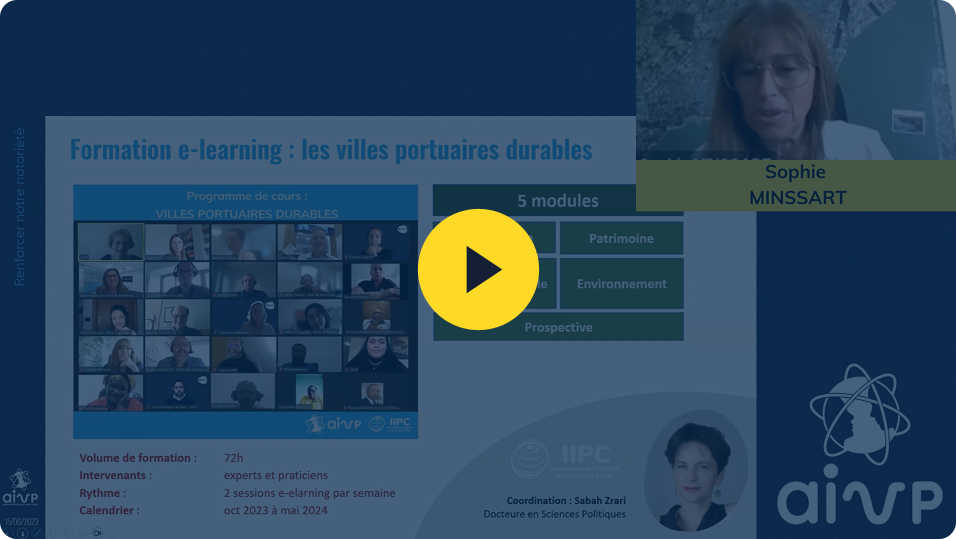
The course program offers a unique opportunity to meet and interact with professionals from all over the world.
Over the course of the sessions, a network of former participants has formed, facilitating reunions and enriching interactions during the activities we organize on a regular basis.
The courses are designed as a practical tool to support professionals in ports and regions in their professional and/or civic activities.
They combine certain theoretical aspects—in particular, the definition of concepts—with practical work based on case studies and fieldwork.
The focus is on the exchange of knowledge among participants in order to make the most of the wealth of experiences and perspectives, whether related to their training or geographic background.
The courses are taught by leading professionals and academics, primarily from the AIVP’s network of experts as well as international organizations
The program brings together professionals from ports, local governments, and civil society in a single training setting, fostering dialogue and an understanding of the perspectives of the various stakeholders.
This program offers a unique framework for reflection, benchmarking, and knowledge sharing. The format allows us to collaborate on developing ideas and to take a step back from our professional topics (…) Personally, I was very enthusiastic about the format, the group, and Sabah’s facilitation—it’s the ideal format!
I don't regret signing up (…) These courses save a lot of time because they allow you to acquire skills more quickly (…). I think all medium- and large-sized port cities should have at least one of their key representatives enrolled in this training program.
This training inspired me to implement many things, including researching data on the port’s impact in order to launch a positive communications campaign. It also prompted me to reevaluate how we perceive the port and its stakeholders.
This training inspired me to implement many things, including researching data on the port’s impact in order to launch a positive communications campaign. It also prompted me to reevaluate how we perceive the port and its stakeholders.
(*) To qualify for the reduced rate, registration fees must be paid by the participant and not by their employer. Employer organizations and labor unions are excluded from the NGO rate. Scholarship Fund: There is a scholarship fund that can help cover part of the registration fees and is available only to individuals and NGOs. It was established through contributions from several faculty members and staff of the French-language program during its first edition. For more information on the terms and conditions, please contact the program’s academic director, Dr. Sabah Zrari.


Access exclusive resources, services and content reserved for AIVP members.
